
Fields in Bacon County Property Tax Records
Bacon County tax research starts by splitting the assessment record from the bill. Two portals hold them. The Board of Tax Assessors' qPublic site publishes the most current digest information and valuation inputs, while the Tax Commissioner portal handles bill and payment access. Pull the same parcel and tax year from both.
| Tax-record field | Meaning | Official source |
|---|---|---|
| Fair market value | Board's annual valuation determination as of January 1 | Tax Assessor |
| Assessed value | Georgia's 40 percent assessment input before exemptions | Tax Assessor |
| Exemption | Approved deduction or preferential treatment for that year | Tax Assessor |
| Net taxable value | Assessed value after applicable exemptions | Assessment and bill |
| Millage and tax | Rate and calculated charge | Tax bill |
| Payment, interest, or penalty | Collection status and additions for the account | Tax Commissioner |
A Bacon County tax bill is not a sale-price record. It is not a private appraisal either. The county's published formula starts with fair market value. Fair market value is multiplied by 40 percent to get assessed value. Exemptions come off next, leaving net taxable assessed value. Then millage applies; one mill means one dollar per $1,000 of assessed value.
Read Bacon County's Current Tax Digest
The qPublic general-information page says fair market value is established annually as of January 1. The record can include land and improvements, classification, exemptions, and other CAMA attributes. Preserve the digest year and any update statement because values can change after appeal or digest approval. The Board determines value; a disagreement over value goes to the assessment process, not the Tax Commissioner.
The captured Bacon assessor landing page identifies the official property-information source and its current-digest caution.
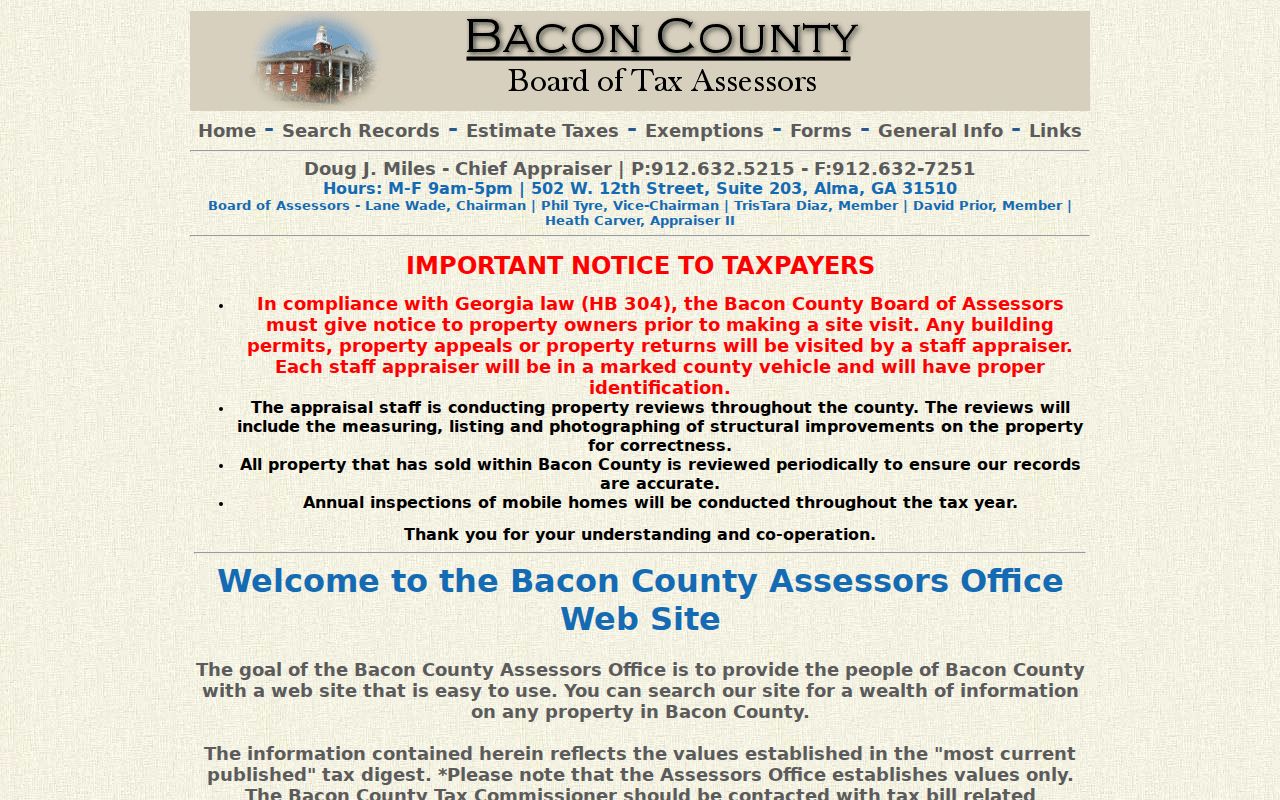
That page is not an individual tax card. No parcel-level owner, exemption, or value should be inferred from it.
Look Up a Bacon County Tax Bill
Use qPublic's parcel ID, then follow a year-specific workflow:
- Open the Tax Commissioner portal and search the parcel or property account.
- Confirm the tax year, parcel/account, owner label, and property address before reading figures.
- Record assessed value, exemption line, net taxable value, taxing authorities, millage, gross tax, credits, penalties, interest, and total due when displayed.
- Compare any exemption with qPublic for the same year.
- For certification, missing years, delinquency, or portal errors, contact the Tax Commissioner rather than treating the payment screen as the legal record.
Tax terms in context
- Assessed value
- The 40 percent assessment input used before deductions and millage.
- Mill
- One dollar of tax for each $1,000 of assessed value.
- Homestead exemption
- A qualifying owner-occupant deduction applied under stated rules.
- Tax lien or FIFA
- A recorded collection claim that must be read with releases and later events.
Bacon sets the normal due date at November 15. The current bill still controls the parcel. The portal may charge convenience fees, and it states plainly that its information is not the legal source.
Use Bacon County's Payment Screen Carefully
The Tax Commissioner is Sarah Hutchinson. Her office sits at 502 W 12th Street, Suite 101, Alma, GA 31510, 912-632-5614. GovernmentWindow support runs on 877-575-7233 and support@governmentwindow.com. Portal support handles technical payment trouble. Only the county office can verify the official account or provide the appropriate county record. The Bacon tax payment screen also posts its online-access notices.

The portal is convenient for a current lookup. For a disputed balance, go to the custodian. Its disclaimer makes county confirmation important before relying on it as formal proof. The Bacon tax FAQ gives the county's formula, due-date, penalty, lien, and ownership-transition explanations.
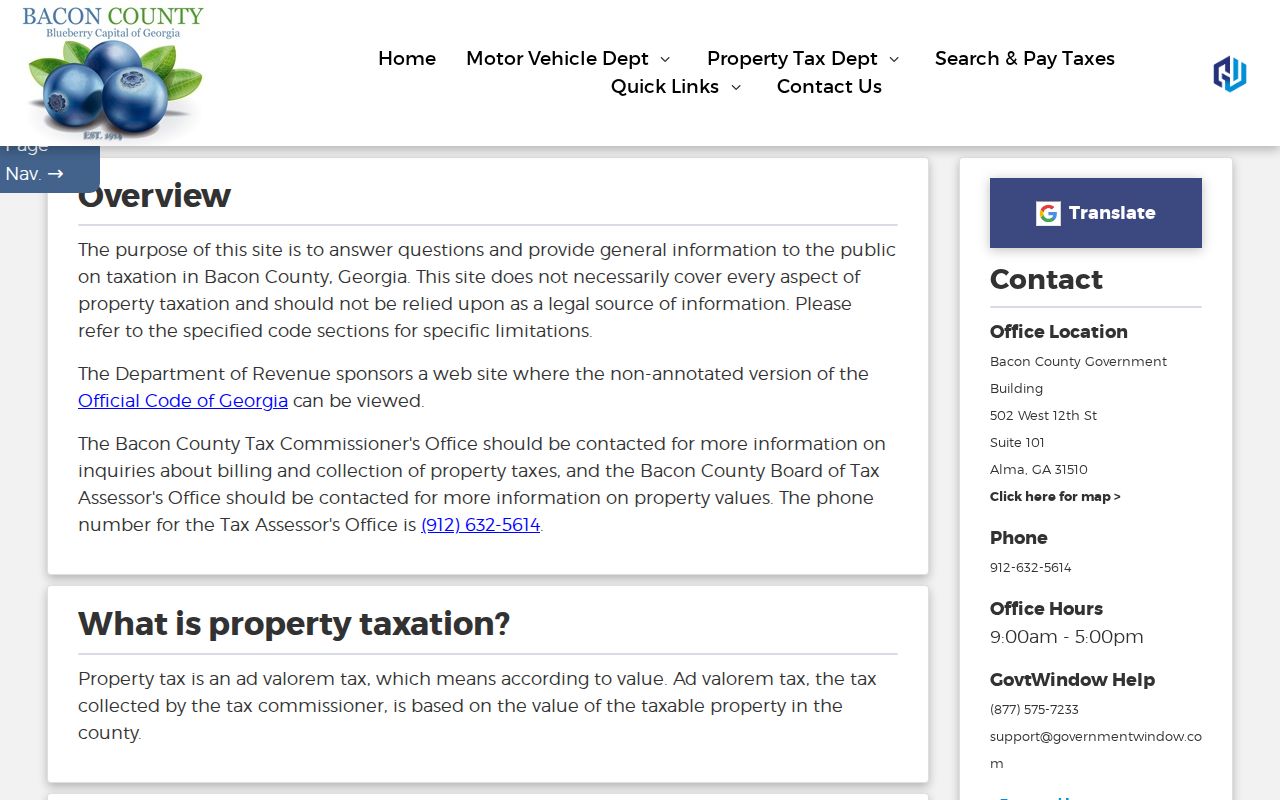
Read those rules beside the current bill and current law. Never compute a balance mechanically from an older page.
Bacon County Exemption Windows and Records
The Bacon qPublic exemption page states a January 1 through April 1 application window and January 1 ownership and occupancy for homestead. The standard exemption is described as a $2,000 deduction from the 40 percent assessed value under O.C.G.A. §48-5-44. It generally renews automatically after initial filing unless ownership or eligibility changes; some trust deeds or name corrections can require refiling, while refinancing alone does not.
The same source separately covers age-based programs, disabled-veteran and surviving-spouse benefits, property-tax deferral, conservation use, and Freeport. Do not assume that any benefit applies to every parcel. Conservation use is described as a 10-year covenant, with a $25 recording fee, a 2,000-acre statewide maximum, qualification tests, and breach consequences. Freeport applies to qualifying business inventory and requires an April 1 application.
The exemption-page capture preserves the official overview.
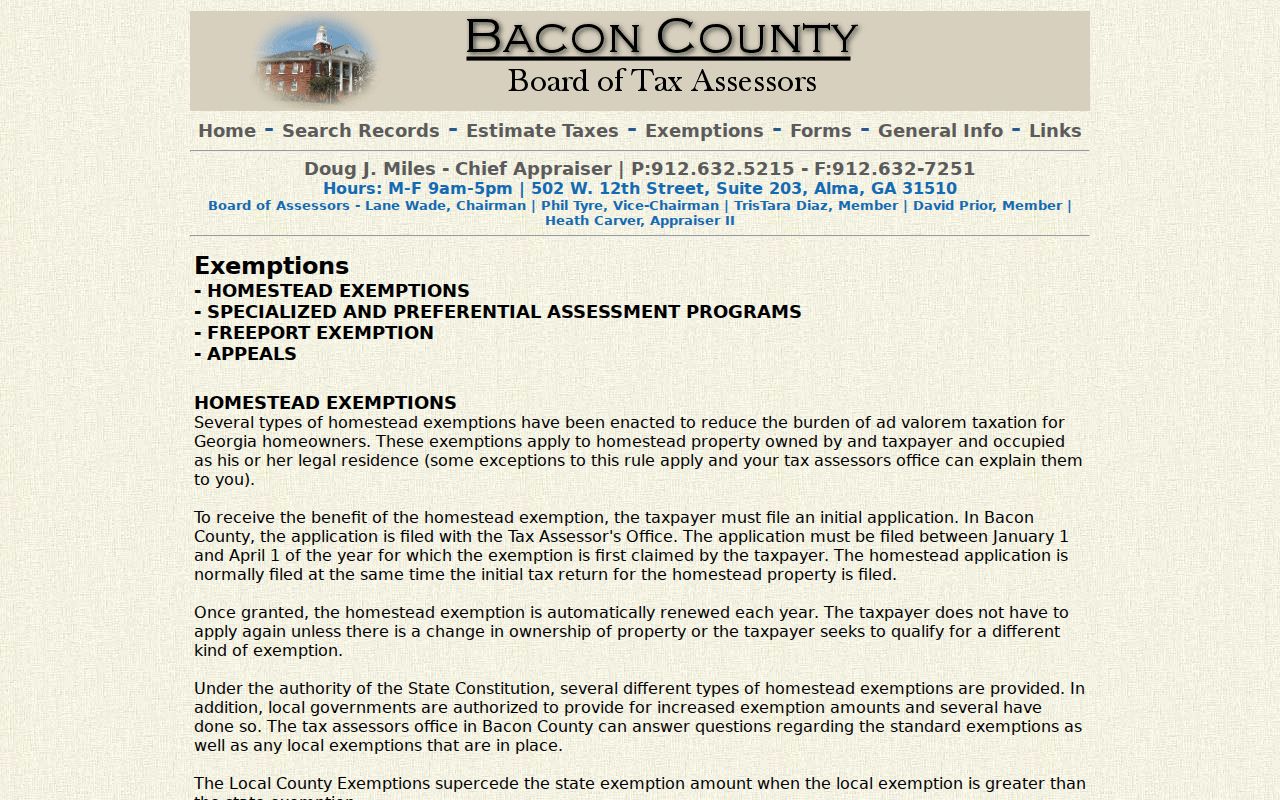
Verify eligibility and the application record with the Tax Assessor. Always tie them to the specific owner, parcel, and tax year.
Contest a Bacon County Assessment
A taxpayer can file a property tax return from January 1 through April 1. If the assessor's proposed value differs, hold on to the assessment notice and its envelope. The notice date controls the appeal clock. Bacon's exemption information states that an appeal can contest taxability, value, or uniformity. The appeal can proceed to the Board of Equalization. An arbitration election is another route. Superior Court review can follow later, if the statutory path is followed.
Assemble the appeal packet piece by piece. Include the notice and the qPublic parcel card. Add comparable Bacon County parcels, the filed return, photographs or improvement facts, exemption documents, and any Board decision. A complaint that the tax bill is too high is not itself a stated ground. Bacon County publishes no online appeal form or Board of Equalization calendar. Contact the Board of Tax Assessors at 502 W 12th Street, Suite 203, Alma, GA 31510, 912-632-5215, Monday through Friday, 9 a.m. to 5 p.m.
Appeal window. A Bacon County assessment appeal must be filed within 45 days of the assessment notice; preserve the notice date and verify the filing route with the Board.
Trace Bacon County Delinquency Events
Bacon County's FAQ explains how a delinquency unfolds. Interest begins right after the due date. A 5 percent penalty arrives every 120 days. It is capped at 20 percent, with homestead and bill exceptions the FAQ describes. Verify the current bill and the statute before calculating. Once a bill sits unpaid past 30 days, the FAQ says a tax lien, called a FIFA, is recorded with the Clerk of Superior Court. It becomes public. That filing is open to anyone.
A clear delinquency trail separates notice, balance, FIFA, levy, tax sale, redemption, and cancellation. It also covers any later conveyance. Search the tax office, the GSCCCA lien index, and Clerk records together. A lien is not a deed. A tax-sale deed alone cannot answer every later title question.
Bacon County's Six-Year Digest Shift
Bacon County's taxable base keeps growing. The 2025 digest and millage-history material reports combined real and personal property digest values of $276,332,922 in 2020, $316,815,792 in 2021, $345,284,090 in 2022, $409,330,739 in 2023, $417,773,442 in 2024, and $480,191,658 in 2025. The series measures the county's whole taxable base, not a city-only figure and not a forecast. It is not a parcel appreciation index.
| 2020 | $276,332,922 |
|---|---|
| 2021 | $316,815,792 |
| 2022 | $345,284,090 |
| 2023 | $409,330,739 |
| 2024 | $417,773,442 |
| 2025 | $480,191,658 |
One caution applies. The 2025 notice was dated December 3, 2025. A digest total should stay tied to its tax year, meeting context, proposed millage, and rollback-rate language, because it cannot establish an individual Bacon County property's fair market value or bill.
Request Missing Bacon County Tax Records
Precision speeds up any records request. Ask the assessor with a parcel ID, tax year, and notice date in hand, and say whether the matter concerns valuation, an exemption, a return, or an appeal. The Tax Commissioner needs different details. Give the account and bill year. Say whether it concerns payment history, delinquency, a FIFA, or a closing allocation. The FAQ adds a closing rule. The January 1 owner stays tied to the annual bill unless a closing statement arrives within 90 days after the due date showing the new owner is responsible. That handling never rewrites the deed.
When a record is not posted, use Bacon County's Open Records Act form. The form cites O.C.G.A. §50-18-70 et seq. Retrieval is free for the first 15 minutes, then direct administrative cost applies, with ten cents per copied page. Keep the written response, fee estimate, any cited redaction exemption, and the files produced, and read a no-record answer as just that, not proof that nothing exists.