
What Bacon County Deed Records Convey
Deeds, security deeds, liens, and plats all live together. They sit with the Bacon County Clerk of Superior Court. Each deed names the parties. It also states the form of transfer, describes the land, and gives recording references. One document rarely settles every competing claim, though. Read carefully. Bacon County deed records in the statewide index cover far more than simple sales. That is why identifying the document type matters. Sort that out before you try to build a chain of title.
| Recorded instrument | Function in the chain | Reason to inspect it |
|---|---|---|
| Warranty deed | Conveys the grantor's stated interest with warranties | Common transfer document |
| Quitclaim deed | Conveys whatever interest the grantor has without warranties | Interest cleanup or family transfer |
| Deed from estate | Conveys through estate authority | Explains a transfer after an owner's death |
| Foreclosure or tax-sale deed | Records a transfer following a statutory process | Must be read with notices and later instruments |
| Security deed | Records a lender's security interest | Read with assignments and releases |
| Easement or right-of-way deed | Creates a defined use interest | May affect access without changing the tax owner |
Go straight to the legal description. Then read every plat it references. An address or tax-map line only helps you find the parcel, while the recorded instrument in Bacon County may rely on subdivision lot and block, land lot and district, metes and bounds, acreage, easements, or reservations to define what actually changed hands.
Search Bacon County Parties in GSCCCA
Start with the GSCCCA Real Estate Name Search, the main online index for parties. Pick Bacon County from the list. It appears as value 3. From there you can search All Parties, Grantor, or Grantee. The portal asks for a last name first when you search an individual. The name field takes up to 70 characters. Dates are optional in mm/dd/yyyy form. Results can display 5, 10, 25, 50, 75, or 100 rows in three layouts.
| Control | Choices observed | Use |
|---|---|---|
| Party type | All Parties, Grantor, Grantee | Follow a recipient or transferor |
| County | All Counties or Bacon | Keep the chain local |
| Neighbors | Yes or No, default No | Add nearby counties only when warranted |
| Date | Optional range | Narrow a known ownership period |
| Display | Three layouts and six row counts | Create an auditable result set |
The successful GSCCCA name-search capture shows these fields.
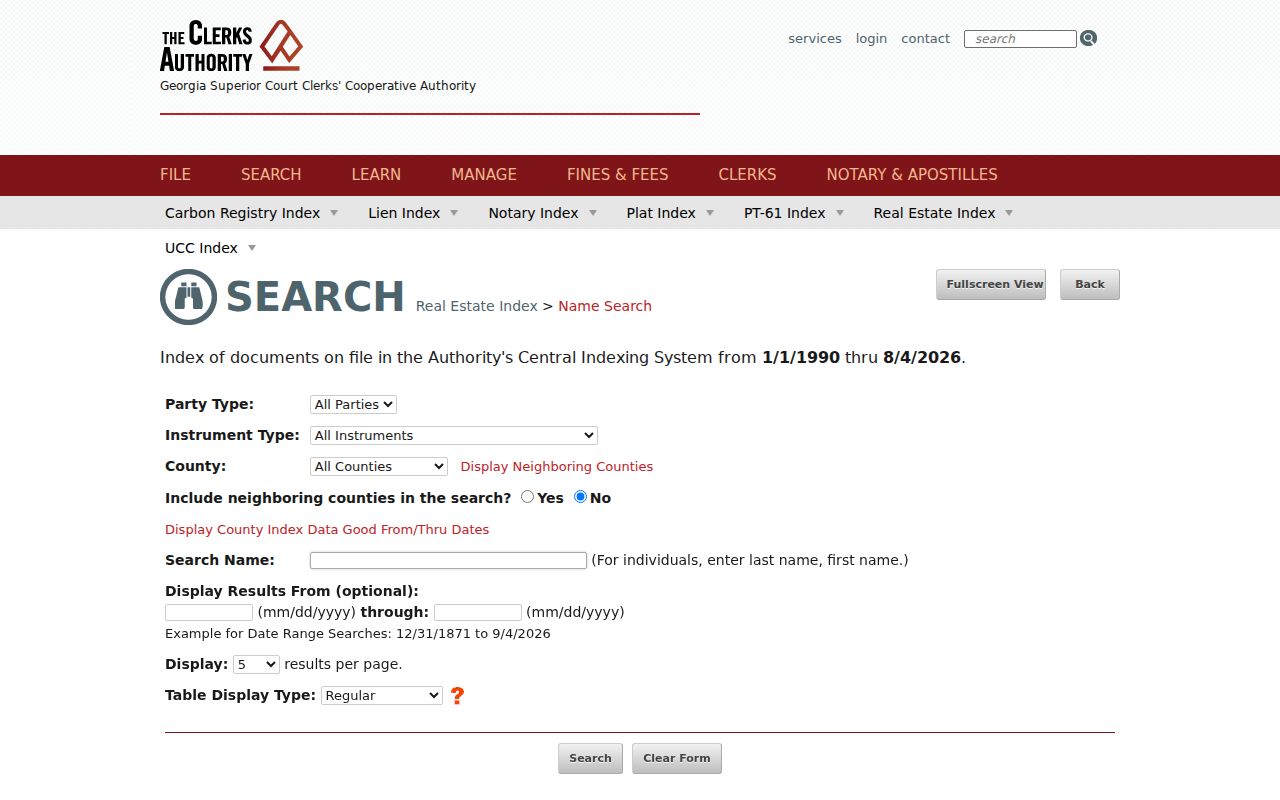
Record the role, county, date range, spelling, neighbor setting, and layout alongside every Bacon County deed records result.
Walk Bacon County's Grantor-Grantee Chain
Start with the owner of record shown on the current Bacon County tax roll, but treat that name only as a lead. From there, trace a dated grantor-grantee chain through the deed records, working backward one instrument at a time.
- Search the current name as grantee and identify the newest deed plausibly tied to the parcel.
- Capture grantor, grantee, execution and recording dates, deed type, instrument or book/page, legal description, consideration if indexed, plat reference, and image status.
- Search that grantor as grantee to locate the earlier acquisition.
- Repeat backward with initials, married names, estates, entities, and trustee capacities.
- At the online coverage limit, continue through the Clerk or Georgia Archives.
Deed index vocabulary
- Grantor
- The party conveying the stated interest.
- Grantee
- The party receiving the stated interest.
- Chain of title
- The documented sequence of conveyances connected to the same land.
- Book/page
- The recorded-location reference used to reopen an instrument.
Names alone never prove parcel continuity in Bacon County deed records. Match the legal description, prior references, plat calls, and acreage across each instrument. A parcel split, estate deed, correction deed, or quitclaim can resolve what looks like a broken chain.
Reopen a Bacon County Book and Page
The GSCCCA Book/Page Search takes a county, a book number, and a page number. It works well once a name search, a prior-reference clause, a plat citation, or an official document hands you the reference. Keep the system's normalized version of what you entered. It may reformat the input. The official book/page screen shows this continuation path in practice.
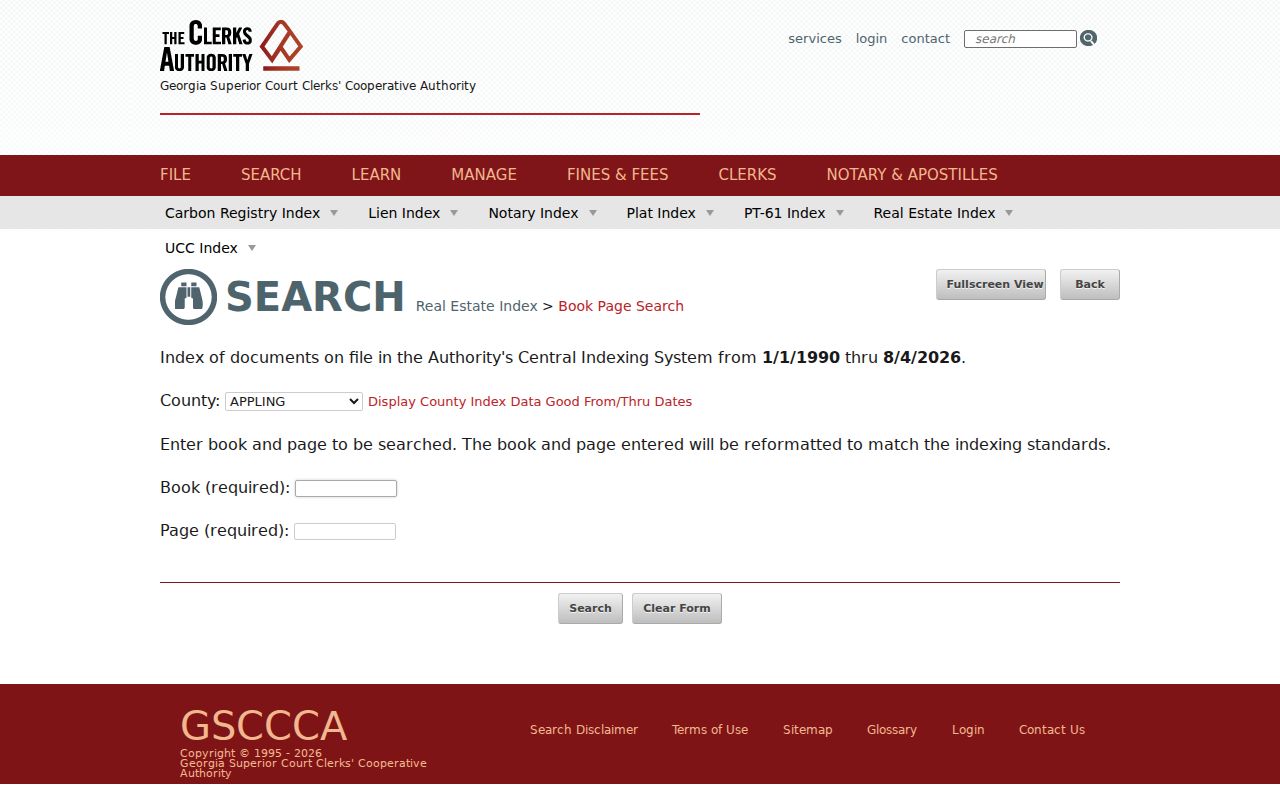
Reopening a book and page in Bacon County works best when the reference came from an official index entry you already trust. Pull the county and citation from that entry first. Then the book, page, and deed date line up without guesswork.
A 2001 Georgia legislative property resolution shows the pattern in miniature. It cites a deed dated December 19, 2001, recorded in Deed Book 311, pages 265-267, with a Plat Book A, page 10-G reference, for property at 426/428 West 12th Street in Alma. Treat that as a citation model and a historical clue. It is not a present title finding for the parcel.
Look Beyond a Bacon County Warranty Deed
A careful Bacon County deed-record review goes past warranty deeds. Security deeds, releases, assignments, and modifications all belong in the sweep. So do easements, restrictive covenants, liens, and plats. A security deed records a lender's interest. It does not prove a current balance. A release speaks only to the interest and the parties it names. An assignment can move that interest. It can do so under a new holder's name.
The GSCCCA Lien Name Search offers county, neighboring-county, name, and date-range controls. It also has row-count and layout controls for this digging. For a reported tax FIFA, compare the tax office with the lien index. Then search for a cancellation, release, redemption, or tax-sale document. The lien-search page keeps those same controls on display.
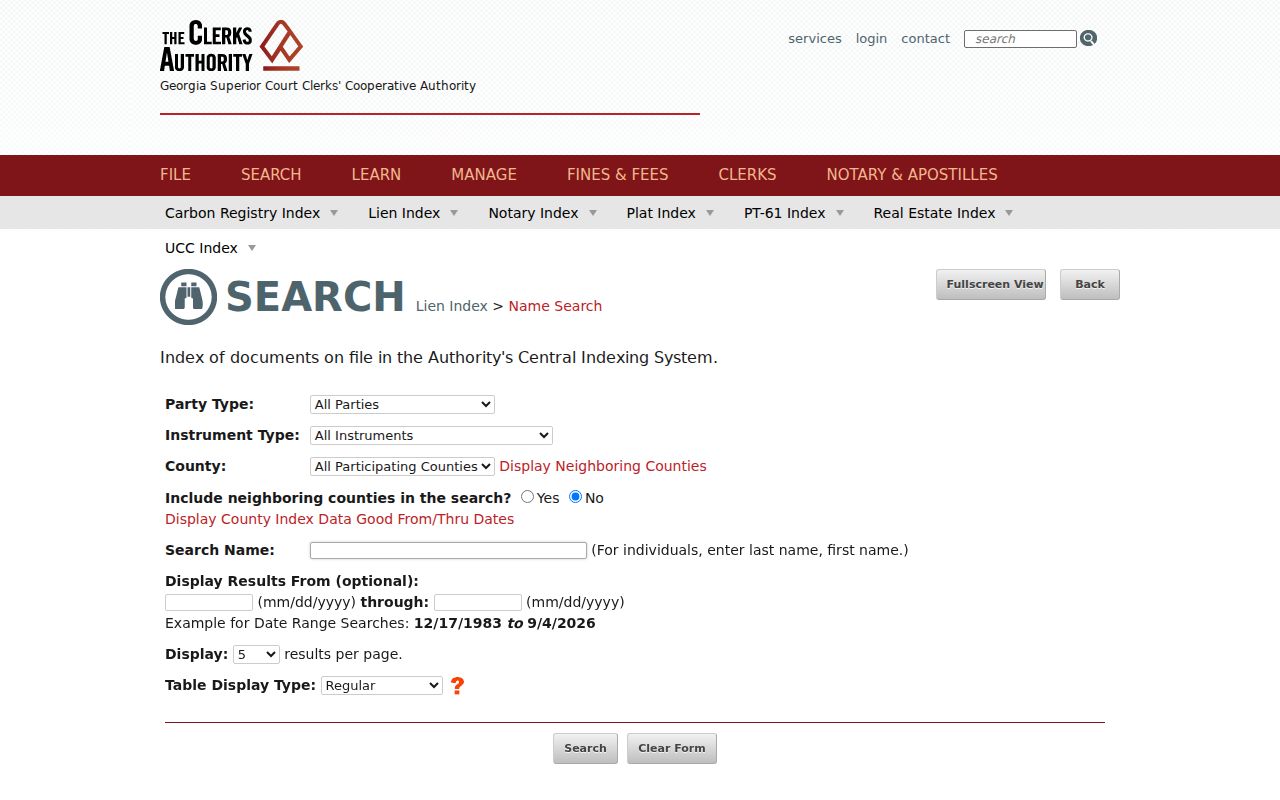
A search result is only a lead, never proof.
Pair Bacon County Deeds with Plats
Deed work in Bacon County pairs well with the GSCCCA Plat Search. You can query by name, by Bacon County or its neighbors, or by section, GMD, district, and land lot. Dates are optional. Rural parcels often turn up faster through a land-lot and district call, a surveyor's name, a grantor, or a subdivision than through a modern street address. A planning map can hint at a location. It proves nothing. The recorded plat controls the lot, the road, any easement, and the dedication language, so treat the plat as the authority once you find it.
The official plat search page displays the geographic fields deed researchers rely on.
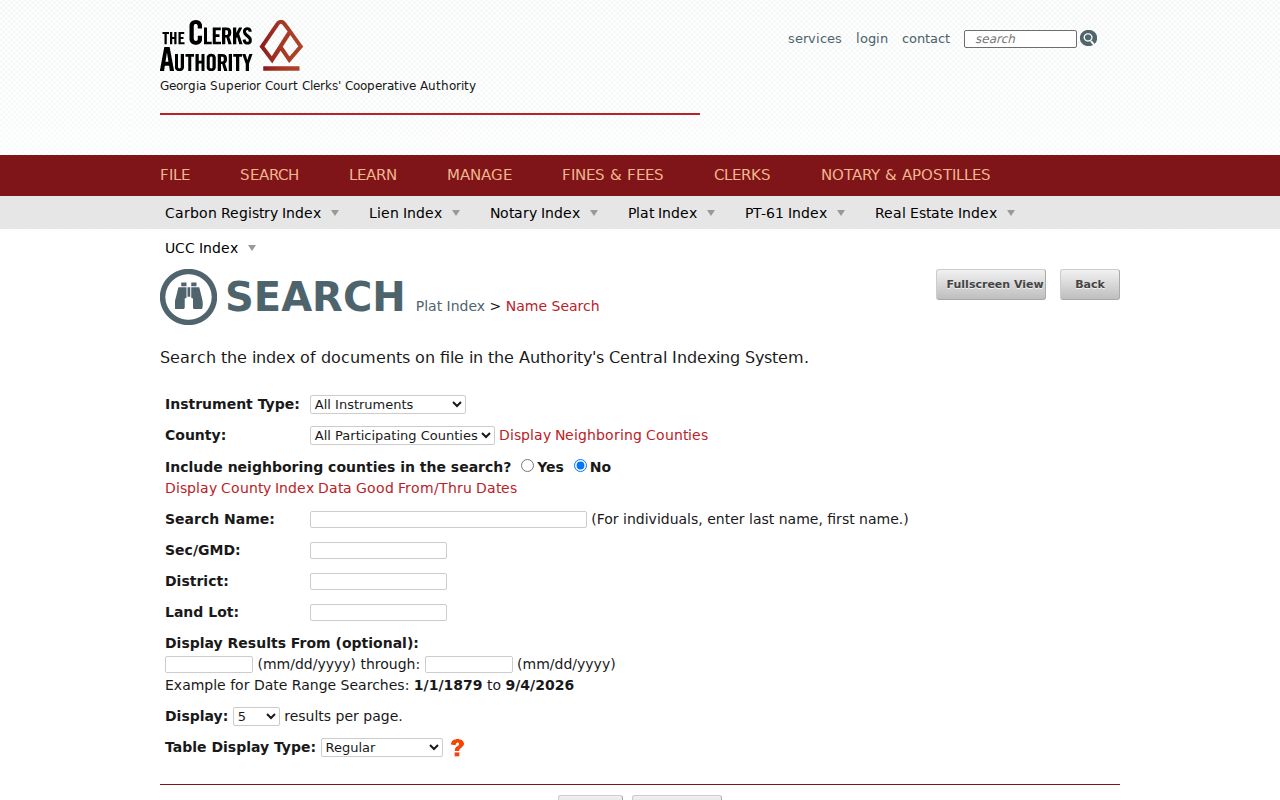
Use district and land-lot fields when address searching fails.
Where Older Bacon County Deeds Continue
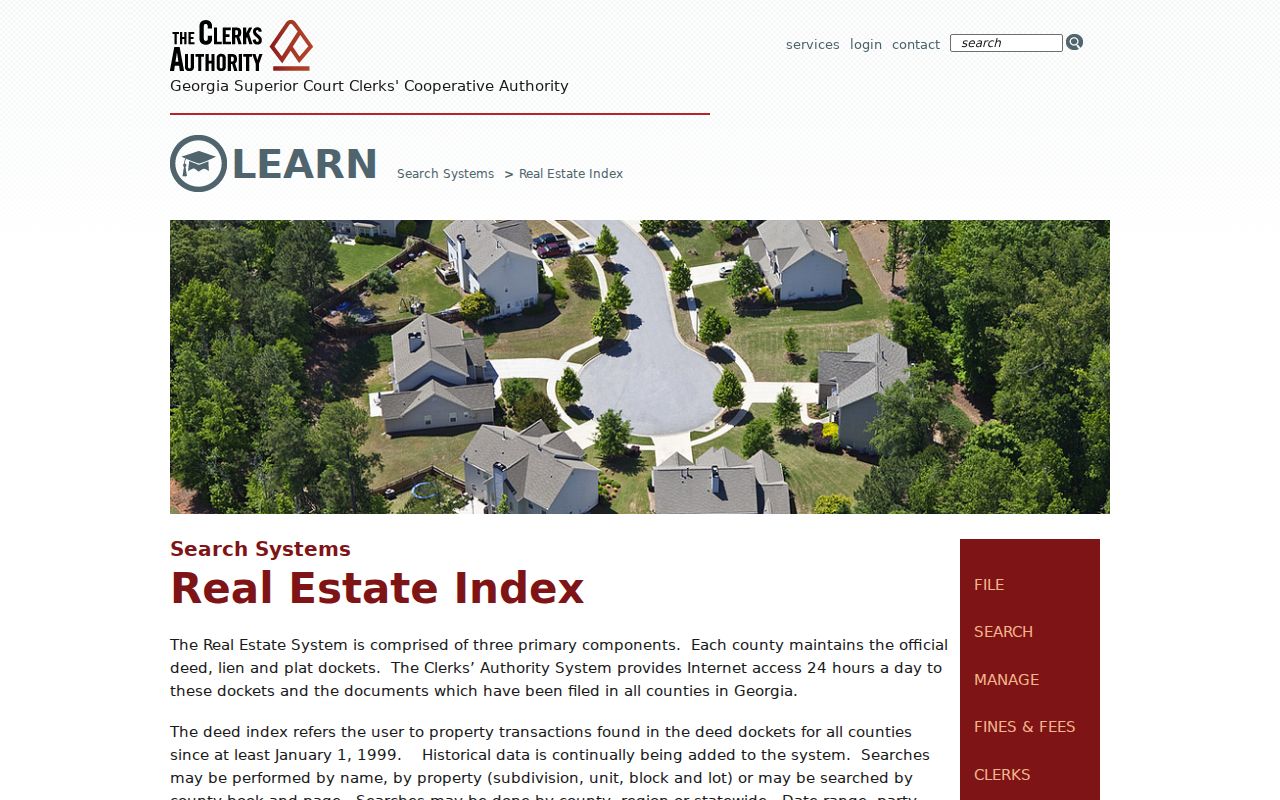
Older deeds continue through the GSCCCA real-estate index. Its own explanation states that deed transactions for every Georgia county reach back to at least January 1, 1999. Historical records are still being added. The index header shows a statewide span of January 1, 1990 through August 4, 2026. That span alone does not prove full Bacon County coverage back to 1990. Check the county's good-from and through dates before you claim any local cutoff.
The index overview on the GSCCCA site describes the service's reach across Georgia deed records.
Treat 1999 as a careful baseline for Bacon County property records. The county's own display and the Clerk's holdings set the real local depth. Deed books go back further at the courthouse.
For anything older, ask the Clerk about deed books and indexes held in Bacon County. The Georgia Archives county cards can help you locate historical runs of deed records. Microfilm and browsable county film can help too. The exact Bacon book ranges run long. So give staff the county, the series, an approximate year, the parties, and any parcel or deed reference you have.
Monitor Bacon County Filings with FANS
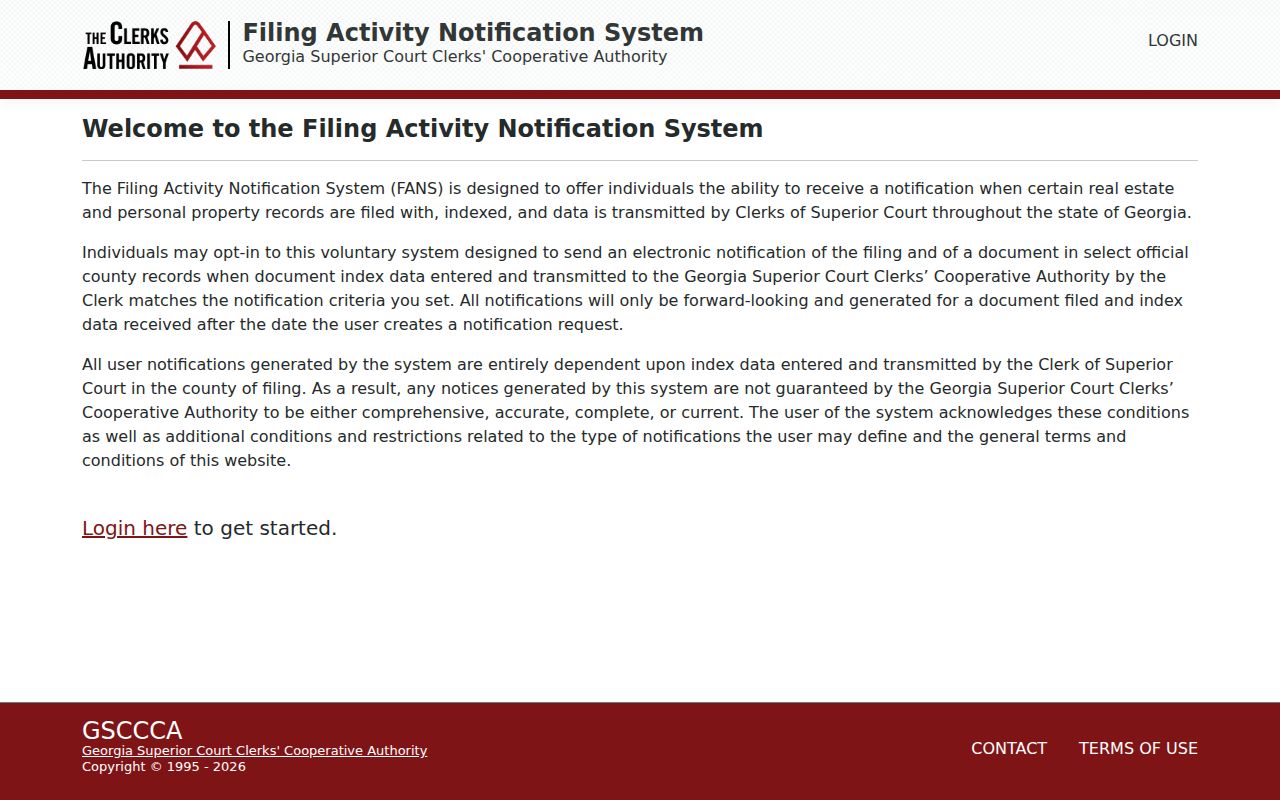
FANS is a free statewide alert service. It watches property filings, personal-property filings, liens, and plats for names and addresses you choose. Before you set anything up, read the deed itself. Register every spelling variant worth watching, because an alert only flags a possible match. It cannot confirm that a filing touches your parcel. It may miss variations you did not list.
The FANS sign-up page pairs statewide registration with the search-alert entry screen.
Monitoring complements, but does not replace, review of certified Bacon County deed records.
Request a Bacon County Deed Copy
Anyone with a GSCCCA account can pull deed images beyond the free index, though premium features and single-image fees carry their own terms, so confirm costs before paying. For plain or certified copies, the office to call is the Bacon County Clerk of Superior Court. Clerk Shawna M. Carver works from 502 W 12th Street, Suite 304, PO Box 376, Alma, GA 31510, and the phone is 912-632-4915. Doors stay open Monday through Friday, 9 a.m. to 5 p.m. Kay Kay Nails handles real-estate questions.
Give the clerk Bacon County, the party names, the deed type, the recording date, and the instrument or book/page reference. Ask two things. Is the image complete, and does your purpose need certification? If a county file is not posted online, the open-records form applies. That form cites O.C.G.A. §50-18-70 et seq., which allows the first 15 minutes free, charges direct administrative cost after that, and sets ten cents per copied page. The records custodian can give you an estimate up front.
Recorded, not guaranteed. Bacon County deed records show what entered the official record, but an index entry is not a title opinion and may not reveal unrecorded interests or legal defects.