
Start a Bacon County Property Search
The right entry point depends on the clue in hand. The Bacon qPublic search works well for an owner. It also handles a location address, a parcel number, or words from a legal description. That record supplies the parcel identifier and the name on the current assessment roll. A party name points instead to the Clerk's statewide deed index. A book and page leads there too. Tax questions go to the Tax Commissioner. Boundary and nearby-parcel questions start on a parcel map.
Keep the roles straight. An assessment card reports tax data, but it is not a deed. A GIS polygon is a reference drawing, not a survey. An index entry is not a title opinion. Let one record supply the search key for the next. Save the parcel ID, names, dates, book and page, and the date each system was checked.
- Search qPublic by the strongest address, owner, parcel, or legal-description clue.
- Copy the parcel ID, displayed owner, physical address, and legal information exactly.
- Use the owner name in GSCCCA and confirm the latest deed by book and page.
- Check the Tax Commissioner portal for the bill or payment question.
- Ask the custodian for a certified copy or an item not posted online.
Offices Behind Bacon County Records
Three offices at the Bacon County courthouse complex answer different property questions. The Clerk of Superior Court records deeds, security deeds, liens, and plats. The Board of Tax Assessors maintains the assessment roll and establishes fair market value each year as of January 1. The Tax Commissioner bills and collects the tax based on the digest. Calling the office that owns the record often saves a failed portal search, especially when an older book, certified image, exemption file, or legal proof is needed.
Bacon County Clerk of Superior Court
502 W 12th St, Suite 304
Alma, GA 31510
912-632-4915
Bacon County Board of Tax Assessors
502 W 12th St, Suite 203
Alma, GA 31510
912-632-5215
Bacon qPublic Search Fields
The assessor's search exposes several useful paths. These modes are not interchangeable. An owner search targets mailing names. An address search targets the location address. A parcel search uses the county identifier. Legal-description terms help with rural land that lacks a clean street address. Search broad terms first, then narrow only after a match appears.
| Search key | Best use | Check in the result |
|---|---|---|
| Owner | Known person or entity | Name spelling and parcel count |
| Location address or range | Known site or street | Physical address and parcel ID |
| Parcel number | Exact cross-system match | Tax year and legal information |
| Legal information | Land lot, block, or subdivision clue | Whether the description fits the deed |
The assessor cautions that its values reflect the most current published digest. The portal is a strong discovery source, not proof that a recent deed has reached the roll. A blank or blocked result should lead to the assessor counter or phone, not to a guess about ownership.
Bacon County Deeds Through GSCCCA
The GSCCCA Real Estate Name Search supports grantor, grantee, all-party, county, instrument-type, date-range, neighboring-county, result-count, and display options. Grantor means the party giving an interest; grantee means the party receiving it. Once a result supplies book and page, the separate Book/Page Search continues directly from there. Bacon County appears as county number 3 in the system.
The statewide index covers transactions for all Georgia counties since at least January 1, 1999. The interface also lists a CIS range beginning January 1, 1990. Bacon County's own good-from date may differ. Treat that display date cautiously. Older or unindexed material belongs with the Clerk, and in some cases Georgia Archives microfilm.
The official deed-search page is where party role, instrument type, county, date, and display settings are chosen. It is the launch point, not the recorded deed itself. Open the GSCCCA Real Estate Name Search.
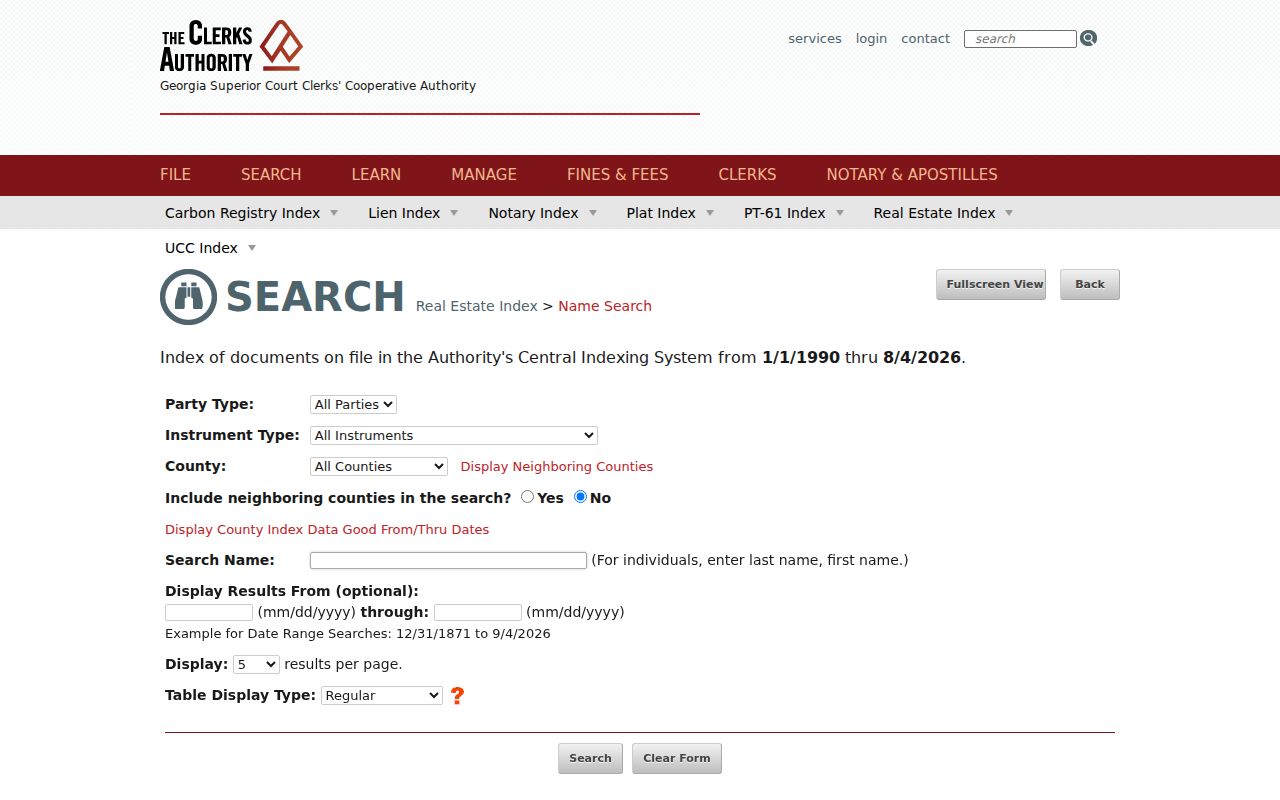
Record the chosen county and filters with each result. That way another searcher can reproduce the path and request the correct image.
Bacon County Property Record Types
A complete parcel file draws on records with different legal jobs. The deed documents a recorded transfer. A security deed or lien may show an encumbrance, and a later release or cancellation adds context. The assessment roll links the parcel to annual values. The tax portal covers the bill and payment route. A plat shows recorded subdivision geometry, and municipal files can show permits or zoning action for land inside Alma.
| Record Type | What It Documents | Kept By | Access |
|---|---|---|---|
| Deed | Recorded transfer, parties, legal description | Clerk of Superior Court | GSCCCA index, office copy |
| Security deed or lien | Recorded claim and related releases | Clerk of Superior Court | GSCCCA real-estate or lien index |
| Assessment | Published owner, parcel, annual values | Board of Tax Assessors | qPublic, phone, counter |
| Tax bill | Bill, balance, and payment route | Tax Commissioner | Payment portal or office |
| Plat and parcel map | Recorded lots and reference polygons | Clerk and assessor data providers | Plat index, qPublic, clearinghouse |
| Alma permit or zoning file | Application, hearing, decision, inspection | City of Alma | City Hall request |
Use the record that answers the actual question. Deed and lien indexes support title research. The roll and bill support assessment and tax work. Detailed transfer research belongs with the Bacon County deed records. Bill dates and exemptions belong with the property tax records. No single record proves clear title or a surveyed line.
Bacon Assessments Use Forty Percent
Georgia assessment rules matter when reading Bacon County property records. The local tax material states that assessed value is 40 percent of fair market value. The Board of Tax Assessors determines fair market value annually as of January 1, and the Tax Commissioner applies the tax process to the digest. Assessed value is therefore a tax input. It is not the same as the amount shown as consideration on a deed, a recent sale price, or a current appraisal.
Exemption records add another layer. Bacon publishes information on homestead, age-based provisions, disabled-veteran relief, conservation use, and Freeport. An exemption can change the taxable result without rewriting the property's market history. Application details may require a direct office request, and eligibility should be checked on the current assessor material.
Bacon Tax Bills Have Their Own Record
The Bacon County Tax Commissioner portal is the online stop for a parcel or property-account bill. It handles any payment question too. The county FAQ gives November 15 as the normal due date. It also covers the 40 percent assessment ratio, exemptions, interest, penalties, and liens. One caveat matters. The portal states plainly that its display is not the legal record. Convenience fees may apply.
That warning should shape your workflow. Save an online confirmation for convenience. But request the Tax Commissioner's record when you need proof. A bill never replaces the assessment notice. Neither one replaces a deed. If a lien or FIFA shows up, hunt for a later cancellation or release. Then ask the responsible office for its current standing.
FANS Watches Bacon County Filings
Georgia's Filing Activity Notification System is known as FANS. It offers a free alert route for property-record activity in participating counties. Bacon takes part in GSCCCA deed, lien, plat, and UCC e-filing. A registrant can build alerts around names, addresses, and the document types the service supports. That makes FANS handy for spotting a new filing. It cannot block, validate, or remove any document. The official FANS registration screen is where an alert subscription begins.
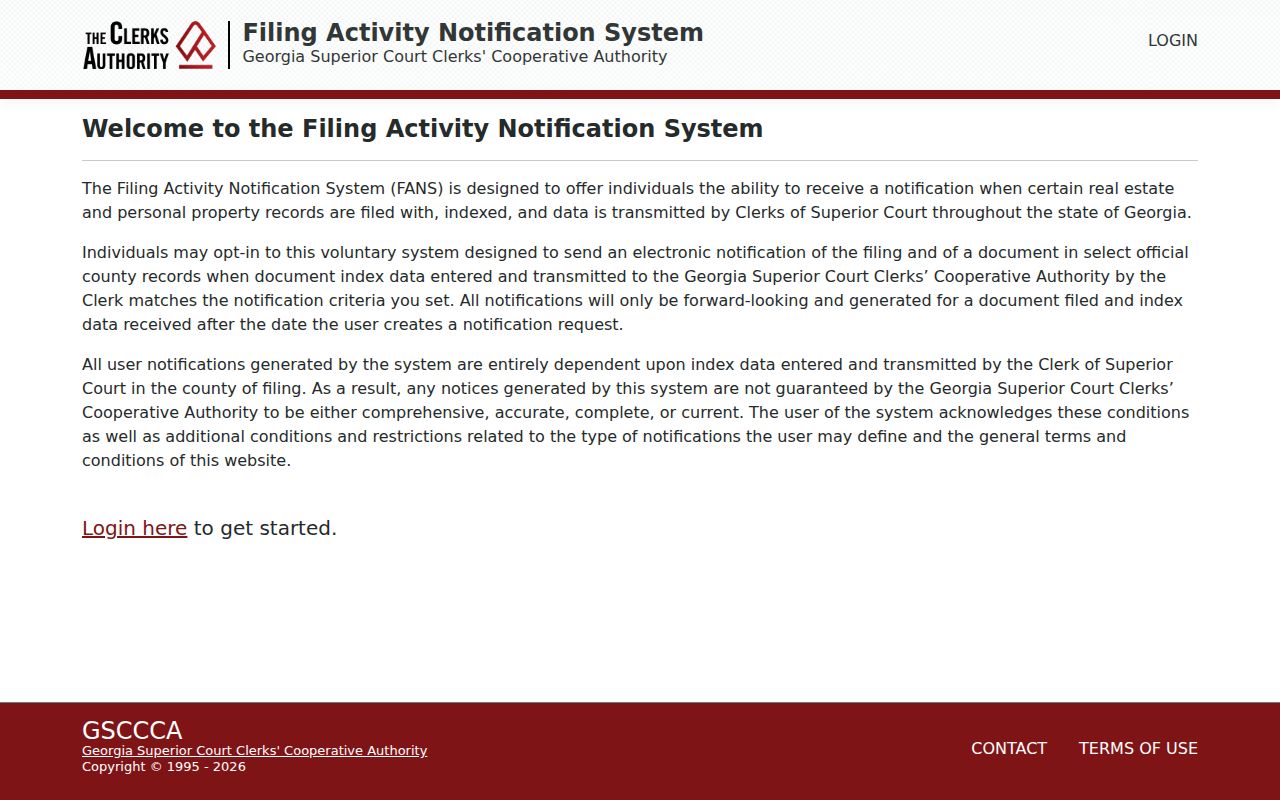
Treat a FANS notice as a prompt, not a verdict. Open the Clerk's index and contact the office. The notice proves neither that the filing is valid nor that the indexed party owns a parcel.
Bacon Parcel Layers Need Context
The Georgia GIS Clearinghouse catalogs a rich stack of layers for Bacon: parcels, CAMA, aerials, address points, road centerlines, land lots and districts, and militia districts. CAMA is computer-assisted mass appraisal data. These layers tie a map shape to a parcel identifier and add helpful geographic context. Bacon publishes no separate ArcGIS viewer. Exact local layer dates and adjacency or buffer tools are not part of the offering.
Remember what a map boundary is. It is a reference line. It is not a licensed survey and should never settle a boundary dispute. For recorded subdivision geometry, run the GSCCCA plat search. You can also ask the Clerk for the plat. For a current parcel ID and assessment value, turn to qPublic or the assessor. One last caution: a rural mailing city or ZIP label may not match municipal limits at all.
Alma Address Labels Can Mislead
Alma is the only incorporated municipality listed for Bacon County in the official Georgia DCA roster. The ZIP reference is 31510, but a ZIP Code is a mail route and a Census ZCTA is a statistical area. Neither proves that a parcel lies inside Alma. Combine the assessor's physical address and taxing field with an official city map, annexation record, or zoning file for a reliable answer.
Preserve each address exactly as its source prints it. Keep the parcel's physical address, tax mailing address, 911 form, and any old street name in separate fields. Historic Alma research may rely on blocks, lots, the Fifth District, and named tracts rather than today's street string. A source-to-source crosswalk is safer than quietly replacing an older description.
Alma Plats Preserve Place Names
Local history supplies unusual search leads for Bacon County plats. A DLG water-system record names Highland Park Subdivision. The 2007 community agenda names Wildernest Subdivision. The National Register nomination for Bacon County School describes early Alma blocks and lots. It also covers the Fending tract and land bought by the Alma Land & Improvement Company. When a modern address fails, plug those names into the plat and deed indexes.
A historic name is a clue, not a title. Match the subdivision, block, lot, land lot, and district to a recorded image. Add the book and page to complete it. Then tie that description to the current parcel record. The 1942 Sanborn map can reveal past buildings, street and block numbers, construction, and uses. It still cannot prove a present boundary, a zoning class, or an owner of record.
Older Bacon Records May Be Offline
When the live index stops short of the deed, tax digest, or probate event you need, the Georgia Archives County Records Microfilm Index is the fallback. County cards tend to emphasize pre-1900 material, though some later runs appear. The Bacon card's exact book list requires direct inspection. Any record-loss notation does too. So claim neither a first surviving year nor a courthouse disaster. The Georgia Archives county-card collection lets you pick the county. You can then work through its series references.
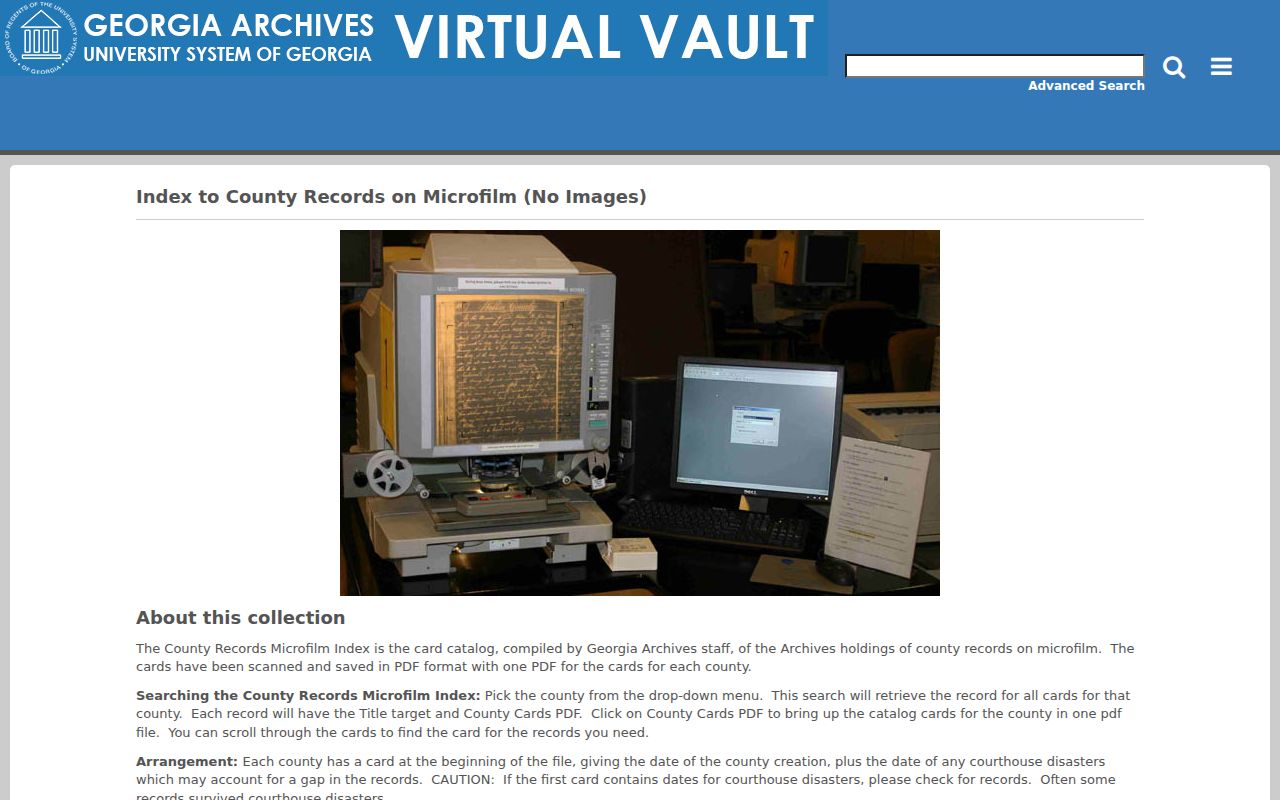
Note everything as you go. Record the collection title, county, book or run, page or image number, and microfilm note. A digital finding aid can identify a record even when the image itself still requires an Archives or Clerk request.
Request Unposted Bacon County Records
Some records never make it online. Bacon County handles those with a written public-records request. The form asks for a description of the record, your contact details, and the date you need it, citing the Georgia Open Records Act, O.C.G.A. §50-18-70 et seq. Send it to County Clerk Mary Lee Sweat. Her office sits at 502 W 12th Street, Suite 200, Alma, or email marylee@baconcounty.org.
Fees start simple. The first 15 minutes of searching are free. After that, the county bills direct administrative cost, and copying runs ten cents per page. Ask for an estimate before any broad production, and confirm current charges with the custodian. Name the record series, the date span, the parcel or address, and your preferred electronic format. For deeds, plats, assessment files, or tax proof, call the office that actually holds the record first.
Limits of Bacon County Property Records
Bacon County property records answer a lot. They show the owner printed on the assessment roll. Recorded transfers, indexed liens, and security interests appear too. Annual tax values and reference maps connect each parcel to the tax roll and plat system.
But limits matter. No index catches every interest. A deed record cannot prove a debt is still unpaid, a GIS line is not a surveyed boundary, and nothing in the file establishes market value. Timing can trip you up as well: a recent transfer may reach the deed index before the tax roll catches the change. Privacy programs and lawful redactions shape what appears, so Georgia Safe at Home and VoteSafe sometimes hide or substitute an address. A missing address is not permission to expose a protected location, and court, voter, registry, and custody systems should never fill a property-record gap.
Lawful use. Use Bacon County records for property diligence, boundaries, tax review, estate work, and civic transparency. They do not replace a title search or survey, and owner information must never be used to stalk, harass, or harm anyone.